
Crazy Frog Ringtones
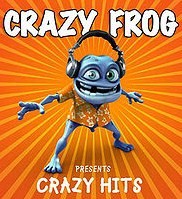 In 1997, 17-year-old student Daniel Malmedahl recorded audio of himself impersonating the noises produced by internal combustion engines. He posted the sounds on a website that caught the attention of a Swedish television researcher, who convinced Daniel to perform the sound live on the air. After the annoying thing debuted on TV, recordings of his performance began appearing on P2P file sharing networks and various websites under the filename “2TAKTARE.MP3″ (“Tvåtaktare” is Swedish for “Two stroker”).
The sound effect was quickly included in Flash animations that spread virally among Internet users becoming an Internet phenomenon. Arguably, the most famous example was the Insanity Test, which challenged listeners to keep a straight face while staring at a still photograph of Rubens Barrichello, a Brazilian Formula One racing driver in a Ferrari Formula 1 car as the outrageous sound effect was played.
In 2004, the German-based company, Jamba! Group (eventually owned by VeriSign who then sold 51% of the group to Fox in 2006) licensed the animation and sound for distribution as a mobile phone ringtone. It is arguably the most commercially successful ringtone of all time. Jamba! has also produced other successful animated creature ringtones, including Sweety the Chick and Nessie the Dragon, and produced other ringtones featuring the Crazy Frog including Crazy DJ Frog. There is also a series of Crazy Frog World Tour tones featuring the Frog performing his usual vocalizations against backgrounds of various countries’ musical styles. These include the sitar-based “Crazy Frog India”, reggae-flavoured “Crazy Frog Jamaica” and John Barnes-esque “Crazy Frog Australian Rock”.
What do you think of the Crazy Frog Ringtone compared to the Mosquito Ringtone? Both of them got their fame from the Internet!
Electronics can Emit High Frequency Sounds Too!
Many older electronics emit high frequency sounds that work on the same principle as the Mosquito Ringtone. A few weeks ago I was in the finance department at a car dealership, buying a car for my 17-year old son. As soon as the old model dot matrix printer started warming up he was asking who was playing the Mosquito Ringtone…… except nobody was, and no one but him heard the buzzing!
This was unusual as there were four adults in the room, including one I know can hear the Ultra Sonic Ringtone, we call the Mosquito Ringtone.
I can remember growing up in the 80′s and hearing those big bulky tube TV’s turn on from across the house because they emitted a very high frequency sound. I don’t however have any idea if current flat panel LCDs and Plasma TV emit those same sounds because I haven’t been able ot hear the ultrasonic ringtone in years! Next time you that the ringtone is annoying or hurts your ears, go find some real old electronics and see if they aren’t worse!
What everyday devices do you know of that emit these Mosquito Ringtone like sounds? – leave your comments below
Mosquito Ringtones – Even a President Can’t Hear Them!
Did you know that based on the average age of people being able to hear the Mosquito Ringtone most of the U.S. presidents would not be able to hear them?
As a result of the condition known as presbycusis, most adults over the age of 24 lose the ability to hear high frequency sounds like the mosquito ringtone. There are no exact numbers but based on polls conducted on our site, we estimate that at least 90% of adults cannot hear the ringtone that high schoolers and college students are using in class to receive cell phone calls and text messages. Seeing as all the presidents are over the age of 24, in fact US law dictates that the president must be at least 35 years old, statistical averages say that only 4 of the 43 Presidents of the United States could have heard the ringtone if they were alive to be tested. As for the 44th president, whether it is Barack Obama or John McCain who wins the election tomorrow, there is only a 1 in 10 chance that either of them would be able to hear the mosquito ringtone if they wanted to, and a 1 in 100 chance that both of them would be able to hear it!
For those that can hear the ringtone, you are able to do something that most Presidents of the United States cannot do and will never be able to do!
*statistics derived from random sampling of website visitors during the first half of 2008 and should not be substituted for actual scientific research in a controlled environment. We are not liable any statistical inaccuracies during the course of our study.
The Mosquito Ringtone is now Available in Multiple Languages!
 We recently added the ability to download and use the Mosquito Ringtone in 23 different languages. By using the Google Translation engine, we will be able to rollout other languages as soon as Google adds them as an option. While the mosquito ringtone was conceptualized in Wales, it quickly spread around the world. It has become a worldwide phenomenon due to the fact that there is no language, no deciphering, just tones! While it may be multi-national in use, it seems to be most popular here in the United States.
The translations will be completed as quickly as time allows, due to certain technical restraints, we can only translate pages every few minutes through the translation engine. All pages in all languages should be completely translated in a matter of days. Enjoy the teen buzz ringtone no matter what country you are from!
Back to School – Time for Free Ringtones
It’s August and what better way to prepare for the new school year then to load up your cell phone with the Mosquito Ringtone! Listen to the mosquito ringtone and download them to your phone for free! The ringtones will enable you to receive text messages and phone calls in class without your teachers hearing them. Many students got new cell phones over the summer and this is a great time to get them ready to show off at school.
There are many great times to use the free ringtones, like when vibrate might still be heard or rattle something in your bag. Show all your friends your new cell phone and show them your mosquito ringtone too!